Call For Paper Vol. 1 No. 1 Juni Tahun 2026
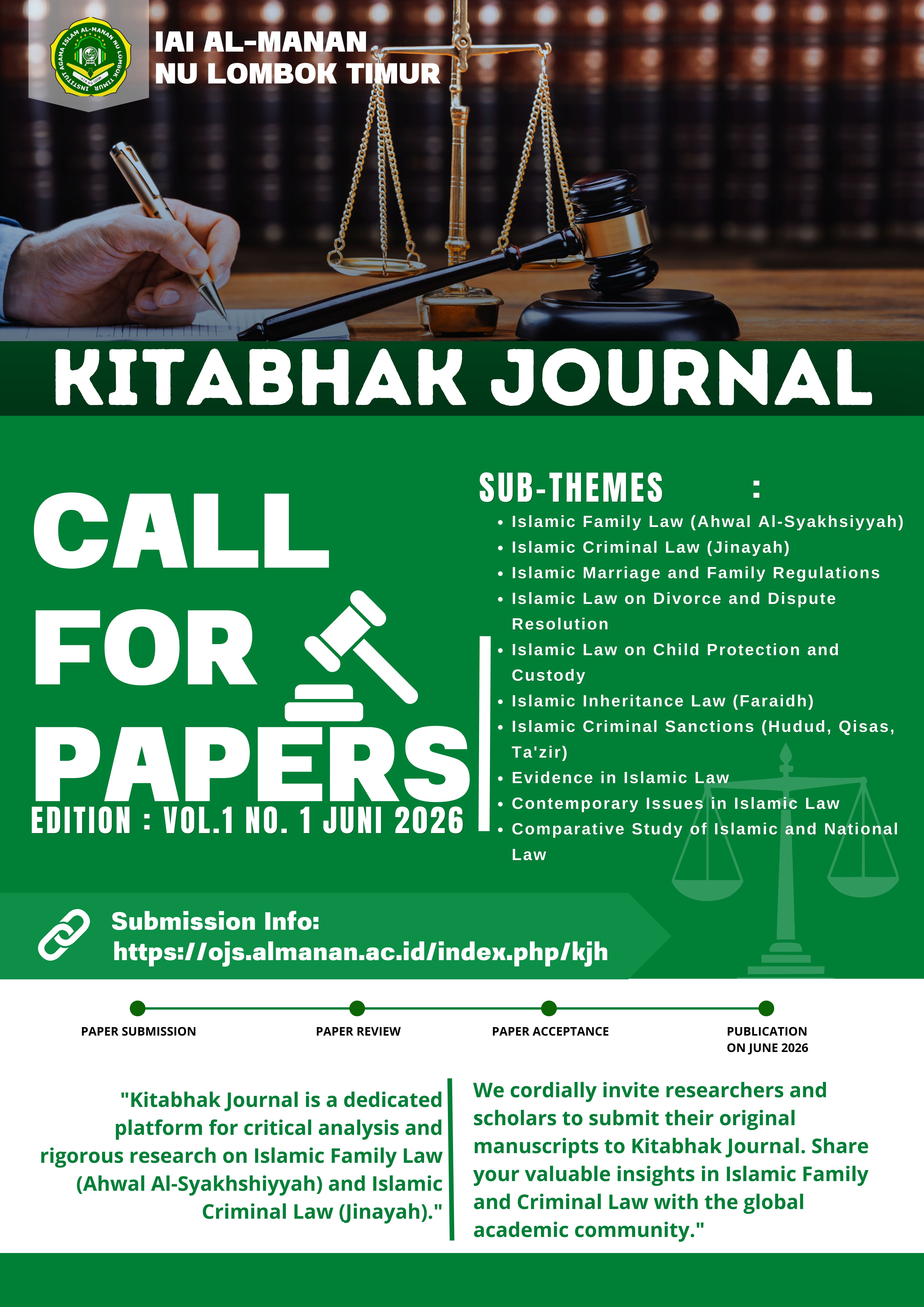
KITABHAK: Journal of Islamic Family Law and Islamic Criminal Law focuses on the study, development, and application of Islamic legal thought, particularly in the fields of Islamic family law (ahwal al-syakhshiyyah) and Islamic criminal law (fiqh jinayah). The journal emphasizes the integration of classical Islamic scholarship rooted in kitab kuning traditions with contemporary legal issues and modern approaches.
The journal aims to serve as a scholarly platform that reflects the richness of pesantren-based knowledge as a primary source of Islamic legal reasoning, while also addressing justice and human rights in present-day contexts. It highlights the role of foundational Islamic sciences (ulum al-din) in shaping legal understanding and practice.
The scope of the journal includes, but is not limited to:
KITABHAK Journal welcomes original research articles, conceptual papers, and critical studies that contribute to the advancement of Islamic legal scholarship. By combining the intellectual heritage of kitab kuning and the foundational sciences of pesantren with contemporary legal discourse, the journal seeks to promote justice, balance, and relevance in Islamic family and criminal law.
Published : Institut Agama Islam Al-Manan NU Lombok Timur
Desa Bagik Nyaka Santri Kecamatan Aikmel Kabupaten Lombok Timur, Nusa Tenggara Barat. Kode Pos: 83653

This work is licensed under a Creative Commons Attribution-ShareAlike 4.0 International License.